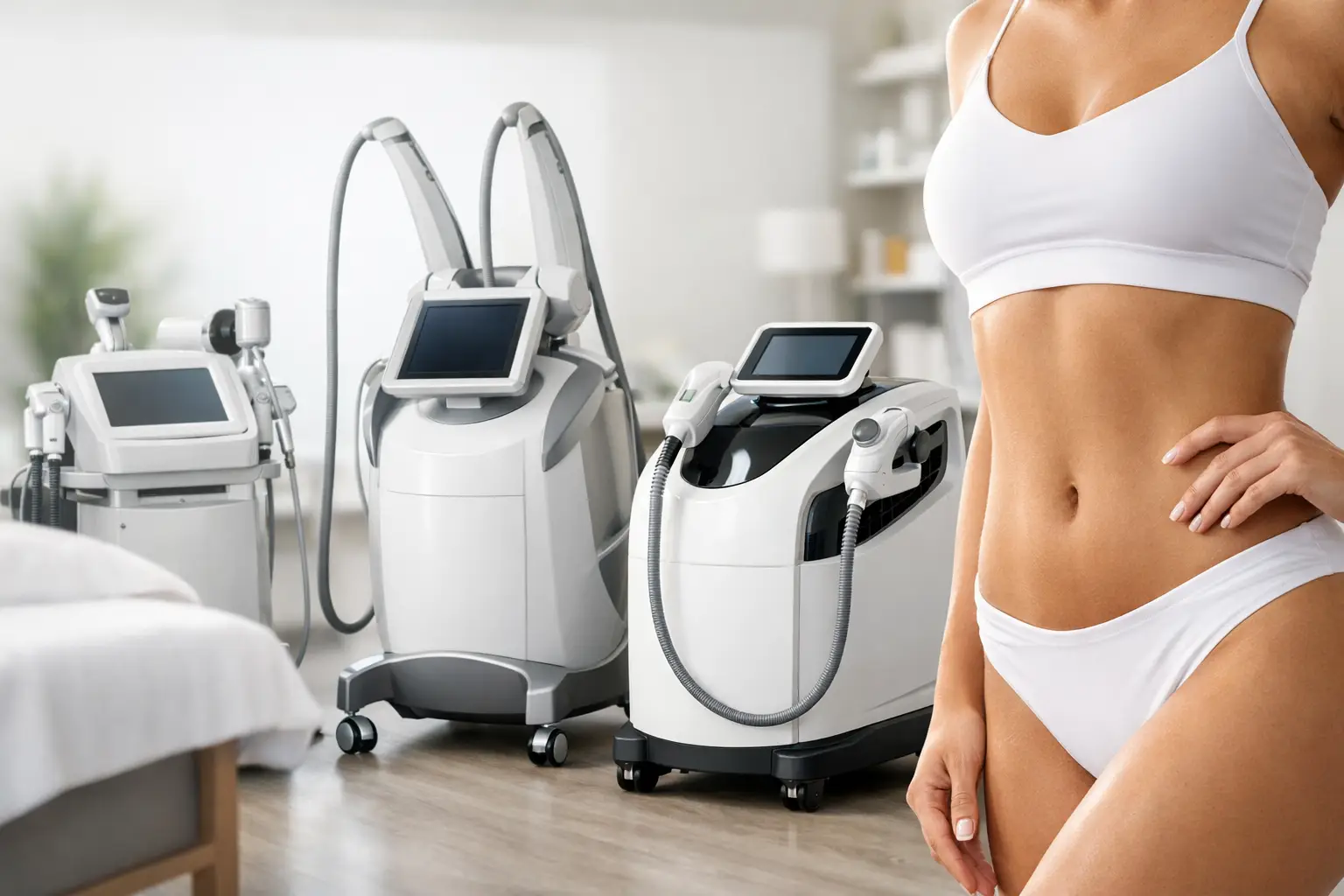
A smart body contouring equipment comparison starts with a business question, not a technology question: what result do your clients want, and what kind of service can your team deliver consistently? A device may look impressive on a treatment menu, but its real value comes from treatment demand, operator workflow, client comfort, measurable outcomes, and its ability to complement the services you already offer.
For med spas, salons, recovery studios, and premium home wellness spaces, body contouring can create a high-value pathway into body shaping, skin tightening, circulation support, and appearance-focused wellness. The right system is rarely the one with the longest feature list. It is the one that aligns with your clientele, staffing model, available space, and revenue goals.
Body Contouring Equipment Comparison by Technology
Most professional body contouring systems use one or more energy-based technologies. Each category has a different treatment experience, ideal use case, operating profile, and client conversation.
Radiofrequency for tightening and texture
Radiofrequency, often called RF, uses controlled heat to warm targeted tissue. In body contouring settings, it is commonly selected for clients seeking a firmer-looking appearance, smoother skin texture, and support for areas where laxity or cellulite appearance is a concern. RF treatments are generally comfortable when delivered correctly, and many systems fit well into a series-based treatment plan.
For an operator, RF can be an appealing foundation technology because it serves a broad audience. It can support body-focused services while also fitting into facial rejuvenation offerings, depending on the device configuration. The trade-off is that outcomes depend heavily on consistent protocol, proper handpiece movement, and a realistic client commitment to multiple sessions.
Look closely at temperature monitoring, applicator ergonomics, treatment presets, and whether the system offers single or multipolar RF. Those details affect operator confidence and treatment consistency more than a generic claim of "skin tightening."
Ultrasound cavitation for body shaping programs
Ultrasound cavitation systems use low-frequency ultrasound energy and are commonly positioned in noninvasive body shaping programs. They are often used on areas with visible, pinchable fat, such as the abdomen, flanks, thighs, or upper arms. For clients focused on silhouette refinement rather than skin firmness alone, cavitation may be a strong fit.
This technology is especially useful when your business wants a body-specific menu with approachable treatment pricing and package potential. Still, it requires careful client screening and clear expectations. It is not a substitute for weight-loss treatment, and it is best presented as part of a body wellness plan that may include hydration guidance, movement, lymphatic support, and repeat appointments.
When comparing cavitation equipment, ask about output consistency, applicator design, safety features, training requirements, and recommended treatment intervals. A low initial price can become expensive if the device has limited durability, inconsistent performance, or inadequate service support.
Vacuum therapy and vacuum RF for circulation support
Vacuum-based body contouring uses suction to lift and mobilize tissue. On its own, vacuum therapy is often used to support circulation and temporarily improve the appearance of cellulite. Combined with radiofrequency, it can create a more comprehensive treatment focused on contour, skin appearance, and tissue stimulation.
For commercial operators, vacuum RF can be an excellent premium upgrade because the treatment feels active and results-oriented. Clients often appreciate seeing a device work across multiple concerns in one appointment. It can also pair naturally with lymphatic-focused services, infrared treatments, compression therapy, or recovery protocols.
The consideration is client comfort. Vacuum intensity must be adjustable, and providers need training to adapt treatments for different body types and sensitivity levels. Systems with intuitive controls, durable hoses, and easily maintained handpieces help protect treatment flow in a busy studio.
Cryolipolysis for localized fat reduction goals
Cryolipolysis uses controlled cooling to target localized fat in selected areas. It has strong consumer recognition, which can make it easier to market to clients already familiar with noninvasive fat reduction. It is generally suited to people who are near their preferred body weight but want to address specific areas that have not responded to diet and exercise.
Compared with heat-based or massage-based treatments, cryolipolysis usually involves fewer appointments per target area and a longer window before clients evaluate visible changes. That can be commercially attractive, but it also means consultation quality matters. Clients need a clear explanation of candidacy, treatment timing, expected sensations, follow-up, and the fact that individual results vary.
This category demands a higher level of due diligence. Cooling performance, applicator selection, treatment monitoring, consumable costs, maintenance requirements, and manufacturer training should all factor into the purchase decision. Buyers should also understand applicable regulatory status and use equipment only according to its cleared, approved, or intended use.
EMS and muscle stimulation for a sculpted appearance
Electrical muscle stimulation, or EMS, is designed to stimulate muscle contractions. In a body contouring environment, it can support a toned, sculpted appearance and complement fat-reduction or skin-tightening services. It is often appealing to fitness-minded clients, recovery studios, and homeowners building a performance-focused wellness space.
EMS is not interchangeable with cardiovascular training or strength coaching. Its strongest role is as an enhancement within a broader body optimization program. For a studio, it can be a fast, repeatable service with strong package potential, particularly when integrated with recovery services such as compression, infrared, or red light therapy.
Compare the number of applicators, program options, session length, sanitation workflow, and whether the system is designed for hands-free operation. A hands-free format can improve staff efficiency and allow a provider to manage the client experience without spending the entire session operating a handpiece.
What Matters Beyond the Technology
The device category tells only part of the story. Before investing, evaluate how the equipment performs as a business asset.
First, consider treatment demand in your market. A luxury med spa with clients seeking visible aesthetic refinement may benefit from a premium cryolipolysis or multi-technology platform. A salon expanding beyond tanning may find that RF, cavitation, and vacuum therapies create an accessible first body contouring menu. A recovery studio may prioritize EMS or vacuum-based services that support both performance and appearance goals.
Second, calculate the full operating picture. Include the purchase price, financing terms, consumables, maintenance, replacement parts, staff training, warranty coverage, required room size, electrical needs, and client acquisition costs. The least expensive unit is not always the most profitable option. Equipment that is dependable, easy to schedule, and supported by responsive service can create more long-term value than a lower-cost device with frequent downtime.
Third, assess the treatment workflow. How long is each appointment? Does the system require a highly skilled provider, or can trained staff follow a clear protocol? Can it be paired with another service in the same visit? Equipment that fits naturally into 30-, 45-, or 60-minute appointments is typically easier to integrate into a high-performing service menu.
Choosing a Single Technology or a Multi-Function Platform
A single-technology device can be the right answer when your business has a defined treatment niche. A dedicated cryolipolysis system, for example, can support a focused fat-reduction offering with clear consultations and premium pricing. A dedicated EMS platform may be ideal for a fitness or recovery business where muscle activation is central to the brand.
Multi-function platforms bring flexibility. Combining RF, cavitation, vacuum, LED, or EMS capabilities allows an operator to customize protocols and address several appearance concerns with one investment. This can be valuable for new med spas and wellness centers that want service-menu breadth without filling multiple rooms with separate devices.
The trade-off is complexity. More modalities require stronger training, more detailed consultation processes, and disciplined treatment protocols. Do not buy a multi-function unit simply because it includes every possible feature. Buy it when your team can confidently explain, operate, and sell each modality.
Questions to Ask Before You Buy
Before finalizing a purchase, ask the supplier what training is included, how quickly service issues are handled, and what maintenance the device requires over its expected life. Request clarity on warranty terms, consumables, installation, and the availability of replacement handpieces or accessories.
You should also ask for realistic revenue modeling. Estimate a conservative treatment price, expected package size, weekly appointment volume, and the time required to reach a return on investment. High-ticket wellness equipment should be evaluated with the same discipline as any other capital investment.
For residential buyers, the same principles apply with a different emphasis. Prioritize safety, ease of use, space requirements, electrical compatibility, and whether the device fits your personal wellness routine. Professional-grade equipment can elevate a home wellness environment, but only if it is practical enough to use regularly.
A strong body contouring program is built around informed consultations, reliable technology, and a treatment experience clients want to repeat. Sun Spa Wellness helps buyers evaluate premium wellness equipment as a long-term operating decision, not just a purchase. Choose the platform that gives your clients a clear reason to return and gives your business room to grow with confidence.
